CargoWise AI Document Automation: Top 10 Documents You Can Automate for Better Logistics Operations
Competing in today’s fast-paced logistics environment involves more than just moving cargo; it also involves moving data effectively. Your operations greatly depend on documents moving smoothly through your system, whether you’re managing air shipments, ocean freight, or multimodal logistics.
CargoWise acts as the backbone of global logistics operations. But here’s the reality:
If your data is still being manually entered from emails, PDFs, and scanned files, you’re slowing down your entire supply chain.
From shipment creation to customs clearance and invoicing, every step depends on accurate document processing. When done manually, it leads to delays, errors, and inefficiencies that directly impact your margins.
This is where Carguber’s AI-powered document automation for CargoWise comes in valuable, transforming how logistics teams manage, validate, and process data within CargoWise.
Why does Manual Document Handling in CargoWise Slow You Down?
CargoWise is designed to centralize logistics operations, but manual data entry creates bottlenecks that limit its full potential.
In manual workflows, teams:
- Spend hours copying data between documents and systems
- Re-enter the same data across multiple modules
- Struggle with inconsistent document formats
- Fix errors after they’ve already impacted operations
Even small mistakes, like incorrect HS codes, shipment values, or container details, can lead to
- Customs delays
- Billing discrepancies
- Compliance risks
As shipment volumes grow, these inefficiencies multiply, making it harder to scale operations without increasing headcount.
How does CargoWise AI Document Automation Work in Daily Logistics Operations?
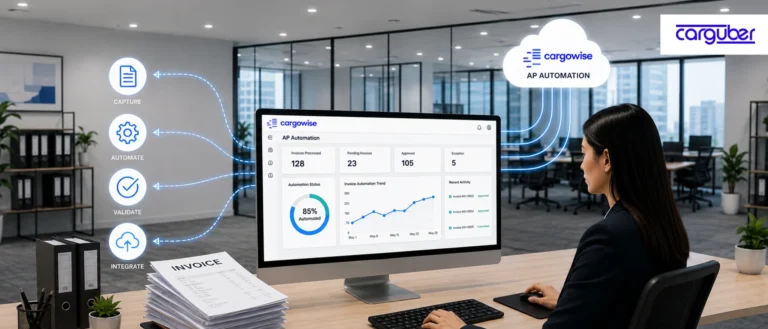
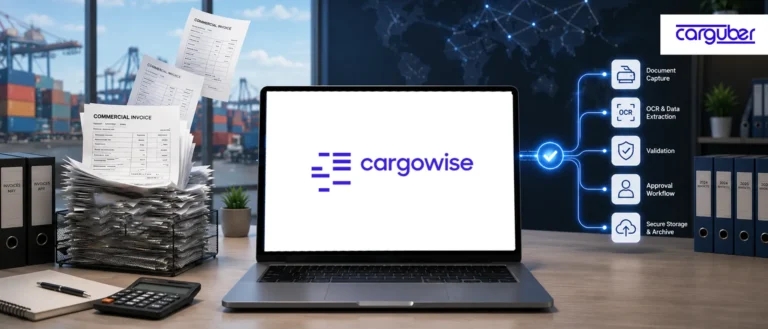
CargoWise AI Document Automation eliminates manual data entry by extracting, validating, and integrating document data directly into CargoWise.
Here’s how it works:
- Documents are received via email, upload, or scan
- AI reads and understands the document content
- Key data fields are extracted intelligently
- Data is validated against business rules
- Clean, structured data is pushed into CargoWise
- Only exceptions are flagged for human review
Unlike traditional OCR, this AI understands context, adapts to multiple formats, and continuously improves over time.
The result is a touchless workflow in which data flows smoothly between operations, finance, and compliance.
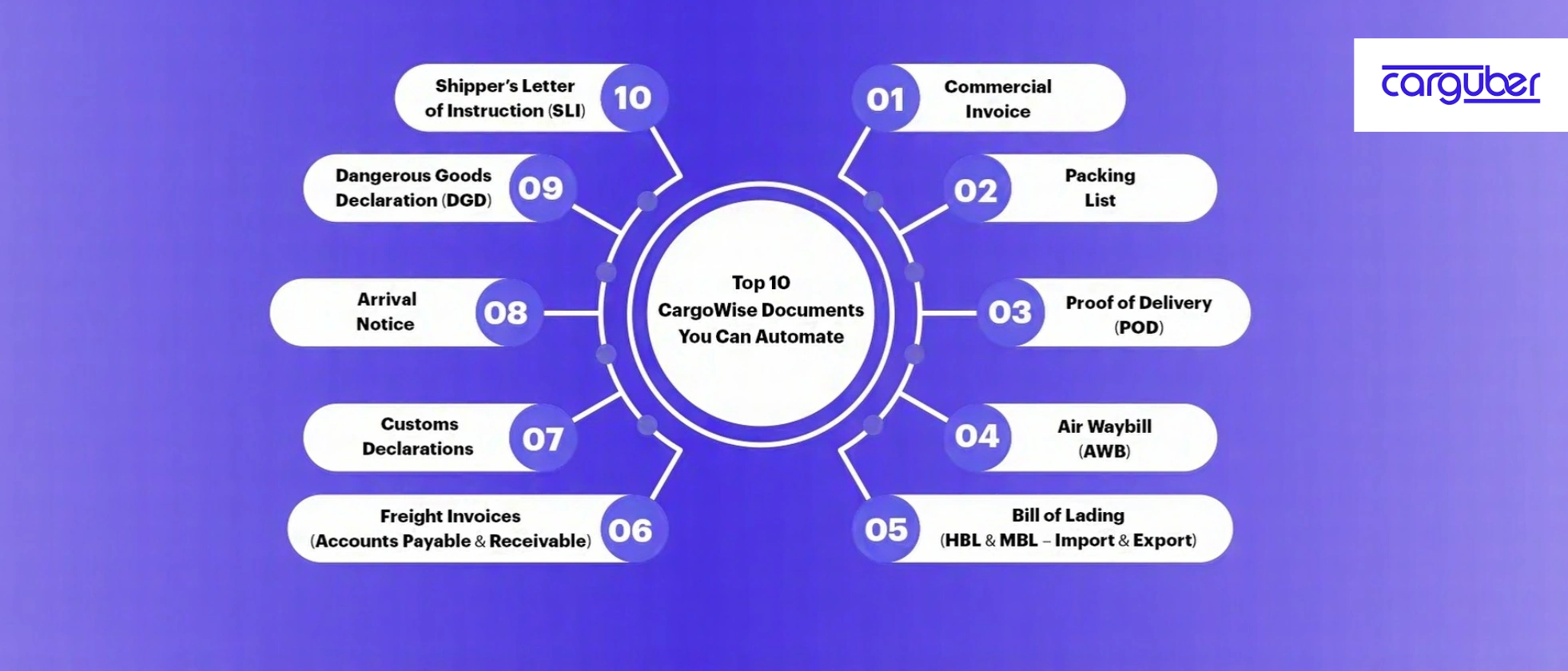
Top 10 CargoWise Documents You Can Automate
1. Commercial Invoice
The commercial invoice is a critical financial document used for customs clearance, duty calculation, and billing.
In manual workflows, teams extract product descriptions, HS codes, and values line by line, which is time-consuming and prone to errors.
With AI document automation, invoice data is captured at a specific level and validated before entering CargoWise. This ensures:
- Accurate customs declarations
- Correct duty and tax calculations
- Faster invoicing cycles
Automating commercial invoices ensures accurate customs declarations and billing, as well as reducing errors and financial disputes.
2. Packing List
The packing list contains shipment-specific details such as quantity, weight, and packaging structure. Manual extraction is challenging due to inconsistent formats and frequent mismatches with invoices.
AI automation standardizes packing data and aligns it with related shipment documents.
This ensures:
- Accurate cargo handling and warehouse planning
- Reduced discrepancies between documents
- Improved shipment visibility
Automating packing list documents improves data standardization and minimizes reconciliation effort by ensuring structured alignment across shipment and invoice data.
3. Bill of Lading (HBL & MBL – Import & Export)
The bill of lading specifies shipment ownership, routing, and carrier responsibilities. Manual entry frequently leads to discrepancies in container numbers, ports, and shipment references.
AI automation allows for the real-time extraction and validation of B/L data. This ensures that:
- Accurate shipment creation in CargoWise
- Consistent routing and container details
- Reduced documentation errors
Automating Bill of Lading Documents (HBL & MBL—Import & Export) ensures consistent shipment data, which reduces errors in routing, documentation, and execution.
4. Air Waybill (AWB)
The air waybill governs air freight transportation, including routing, airline, and chargeable weight.
Delays in manual entry can cause disruptions in tight air freight schedules. AI automation processes AWB data instantly. This ensures that:
- Faster shipment execution
- Accurate rate calculations
- Improved operational efficiency
Automating Air Waybill Documents (AWB) allows for faster processing of air shipments while maintaining accuracy in routing and rates.
5. Proof of Delivery (POD)
The Proof of Delivery confirms that the goods were successfully delivered. Manual updates cause shipment delays and impact customer communication.
AI automation extracts POD data from scanned or digital formats and links it to shipments. This ensures that:
- Real-time delivery confirmation
- Faster job closure
- Improved customer satisfaction
Automating Proof of Delivery Documents (POD) improves real-time visibility and enables faster operational and financial closure. Proof of Delivery Documents (POD)
6. Freight Invoices (Accounts Payable & Receivable)
Freight invoices are critical for controlling costs and revenues. Manual validation increases the chance of overbilling or missing charges.
With AI automation, invoice data is matched and validated automatically. This ensures:
- Accurate cost allocation
- Faster billing cycles
- Improved cash flow
Automating freight invoice documents (Accounts Payable & Receivable) improves billing accuracy, lowers revenue leakage, and accelerates cash flow.
7. Customs Declarations
Customs declarations include the regulatory and compliance information necessary for import/export clearance. Manual errors can result in shipping delays or penalties.
AI automation validates customs data before submission. This ensures that:
- Accurate classification and compliance
- Faster customs clearance
- Reduced regulatory risks
Automating customs declaration documents ensures compliance, reduces clearance times, and mitigates regulatory risks.
8. Arrival Notice
The Arrival Notice informs consignees of the shipment’s arrival and next steps. Manual delays have an impact on coordination and the overall customer experience.
With AI automation, notifications are triggered automatically. This ensures:
- Timely communication
- Better coordination
- Faster cargo release
Automating the arrival notice documents improves communication with consignees and allows for faster cargo coordination.
9. Dangerous Goods Declaration (DGD)
The DGD ensures compliance with hazardous cargo shipments. Due to strict regulations, manual processing is complex and prone to errors.
With AI automation, DGD data is validated against compliance rules. This ensures:
- Accurate hazard classification
- Regulatory compliance
- Reduced risk of penalties
Automating DGDs’ documents ensures that hazardous shipments are properly classified and comply with regulations.
10. Shipper’s Letter of Instruction (SLI)
The SLI provides shipment instructions from the shipper to the forwarder.
Manual interpretation can lead to inconsistencies and errors.
With AI automation, SLI data is standardized and integrated into CargoWise. This ensures:
- Clear shipment instructions
- Better coordination
- Reduced operational errors
Automating the SLI’s document improves clarity in shipment instructions and reduces operational errors.
Before vs After: Operational Transformation
Before Automation (Manual Workflows) | After Automation (AI-Driven Workflows) |
5–10 minutes to process a single document | 30–60 seconds automated processing time |
3–5% average data entry error rate | <0.5% error rate with validation |
2–3 hours’ delay in shipment creation | Real-time or near-instant job creation |
20–30% of time spent on manual data entry | <5% manual intervention (exception-based) |
Frequent mismatches across documents | 95%+ data consistency across systems |
With Carguber’s AI document automation in place, logistics teams can dedicate their time to shipment execution, exception handling, and customer service rather than hours of repetitive data entry.
Instead of chasing documents and fixing errors, teams benefit from real-time control, faster turnaround, and greater financial accuracy, all without increasing operational workload.
Conclusion
Small inefficiencies in logistics compound over time, affecting every shipment, document, and transaction.
Manual document handling may appear manageable daily, but it gradually slows operations, increases errors, and quietly reduces your margins. CargoWise is intended to streamline global logistics, but its full potential is realized only when data enters it accurately and in real time.
By automating your most critical documents, such as commercial invoices, bills of lading, customs declarations, and freight invoices, you can create a connected, intelligent workflow in which operations, finance, and compliance all work together.If your team is still spending hours on document processing, it’s time to rethink your approach. Contact us today to see how Carguber’s AI document automation can improve your CargoWise workflows and give your logistics operations a competitive advantage.