Your supply chain might already be digital. But if your documents are still handled manually, your operations are only halfway there.
Every shipment depends on documentation, purchase orders, invoices, bills of lading, and customs declarations. These are not just supporting files; they are critical to execution, compliance, and financial accuracy.
However, a large portion of document workflows in the industry continues to rely on manual effort. Even within advanced ERP systems like CargoWise and SAP S/4HANA, teams often enter, validate, and reconcile data step by step.
This disconnect between digital systems and manual execution is now one of the biggest inefficiencies in modern supply chains.
🌍 What’s Changing in Document Processing Today?
Global supply chains are changing rapidly. According to recent industry insights, digital transformation in logistics is accelerating, with organizations focusing on automation, real-time visibility, and data accuracy.
Several changes are influencing document processing today:
- Trade volumes continue to increase, leading to higher document loads
- Regulatory requirements are becoming more complex across regions
- Businesses are investing in integrated ERP ecosystems
- Customers expect faster updates and greater transparency
In this environment, manual document handling is no longer feasible. What was once effective in slower, localized operations now causes delays and risks in global, high-volume supply chains.
As a result, businesses are transitioning to automation, in which document workflows are integrated directly into system processes rather than handled separately.
📊 Why is AI document automation gaining momentum?
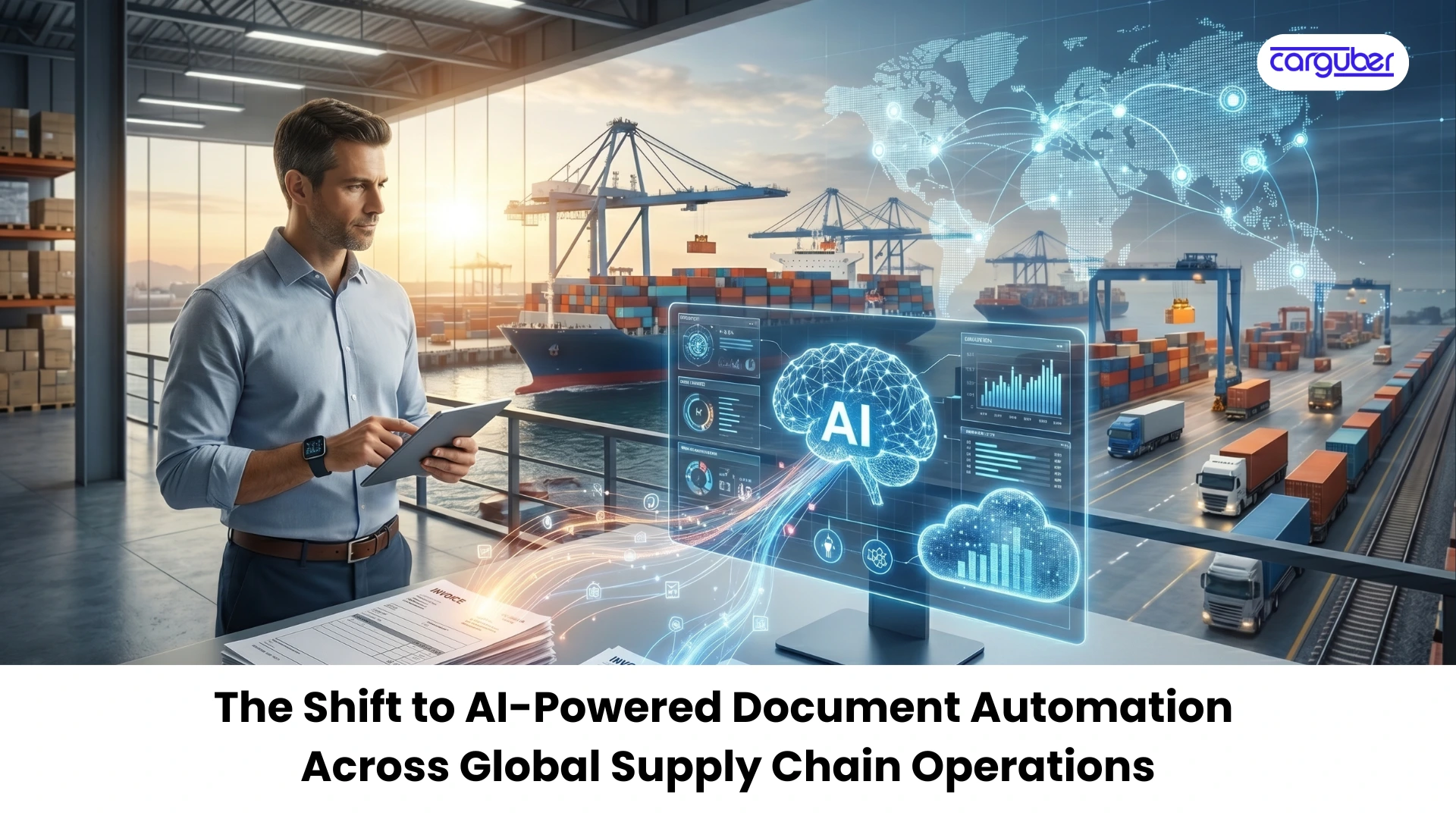
AI-powered document automation is emerging as a feasible solution to these problems. It allows systems to process documents intelligently, without requiring repetitive human intervention.
Instead of manually entering and validating data, AI can:
- Extract information from structured and unstructured documents
- Match document data with ERP records in real time
- Detect discrepancies and trigger exceptions
- Automate validation, approvals, and updates
This shift significantly reduces processing time while improving accuracy. More importantly, it enables ERP platforms to evolve from static data repositories to active operational systems capable of real-time decision-making.
📉 The Hidden Cost of Manual Documentation
Manual document handling often appears to be manageable, but its impact grows over time.
Across logistics operations, it results in;
- Delays in processing that affect shipment timelines
- Errors that require correction and rework
- Misalignment between operational and financial data
- Limited visibility across departments
These inefficiencies scale with increased document volumes, affecting overall performance and customer experience. Manual processes cause disruptions in a connected supply chain, reducing accuracy and speed.
🔍 How does AI improve ERP capabilities?
When AI is integrated into logistics ERP systems, document workflows improve connectivity and efficiency.
Instead of handling documents individually, systems can automatically process, validate, and share data across operations, finance, and compliance functions.
This enables:
- Real-time synchronisation of information
- Reduced dependency on manual data entry
- Improved financial accuracy and compliance
- Faster response times across workflows
The result is a more responsive and scalable operating environment.
🤔 How Effective is Your Document Workflow?
Take a moment to evaluate your current processes
- Are documents still entered manually across systems?
- Do errors lead to delays or repeated work?
- Is document status visible in real time?
- Are approvals slowing down your workflow?
If these challenges exist, the problem is not with the ERP system, but with the lack of automation in document workflows.
This is where AI delivers measurable impact.
📊 Why does this Shift Matter More than Ever?
Today’s supply chains face constant pressure to move faster while maintaining accuracy.
Rising volumes, shorter timelines, and more stringent compliance requirements necessitate efficient workflows that can scale without increasing operational effort.
AI-powered document automation supports this by:
- Accelerating processing across departments
- Improving accuracy and consistency
- Enabling real-time visibility and coordination
- Supporting faster, data-driven decisions
Efficiency in modern logistics is determined not only by the movement of goods but also by the speed and accuracy with which information flows.
🚀 Final Thoughts
The goal of AI-powered document automation is to improve the performance of existing systems rather than replace them entirely.
Organizations can reduce delays, improve accuracy, and operate more efficiently by transforming document workflows into intelligent, automated processes.
The transition is clear: from manual handling to system-driven execution.
Need help optimizing your document workflows?
If your document processes remain manual, it may be time to adopt a structured approach.Get the right logistics support and helpdesk to streamline workflows, improve ERP efficiency, and provide real-time visibility throughout your operations, allowing your team to focus on higher-value tasks.