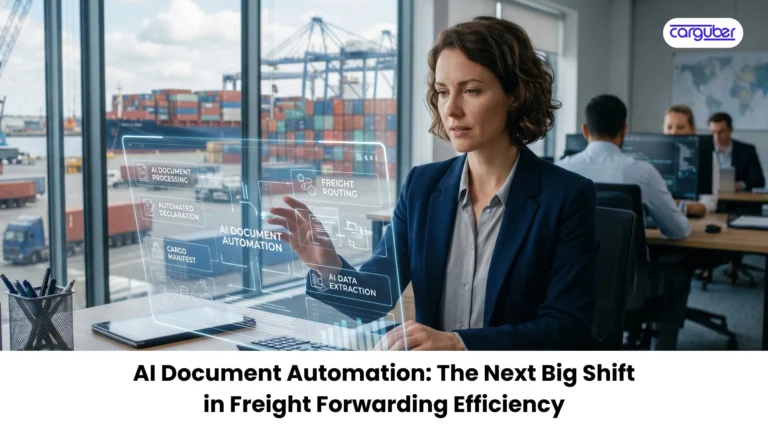
Artificial intelligence is quickly becoming a major focus in logistics and supply chain management. Businesses are looking for ways to improve efficiency and decision-making using AI copilots and automation tools, as well as intelligent assistants and large language models.
However, AI alone is not a game-changer.
Organizations with strong data foundations, connected operations, and deep logistics expertise will benefit the most from artificial intelligence.
🤖 AI is Only the Frontend
Many businesses are implementing AI via chatbots, assistants, and workflow automation tools. These solutions can improve productivity and simplify daily tasks, but they frequently build on top of existing processes.
The real opportunity is not simply to accelerate old processes. It is rethinking how work is done.
As Zubin Appoo, CEO of WiseTech Global, explains, logistics professionals should not spend valuable time searching for information during disruptions. The right information should reach them when they need it so they can act quickly and confidently.
That’s the distinction between AI as a feature and AI as operational infrastructure. Surface-level AI accelerates traditional workflows. Transformative AI questions whether those workflows should be kept unchanged at all.
📊 Data Creates the Real Advantage
A common misconception is that AI models create a competitive advantage.
In reality, AI is only as powerful as the data behind it.
Logistics data includes shipment history, customs activity, carrier performance, compliance records, routing decisions, booking patterns, and operational workflows. When AI can access and understand this information, it delivers far more meaningful outcomes.
A generic AI tool may summarize a trade disruption.
As Zubin Appoo says, “Data becomes king.” AI requires the appropriate data layer to make intelligent decisions.
Logistics data includes shipment history, customs filings, freight movements, carrier connections, compliance records, tariff logic, routing patterns, booking behavior, and execution workflows. When AI is applied to this type of operational ecosystem, the results are far more valuable than generic answers.
An AI-powered logistics platform can identify affected shipments, recommend alternative routes, estimate delays, assess costs, and support faster decisions.
That is operational intelligence.
🌐 Connected Networks Drive Better Decisions
Supply chains operate as ecosystems, not isolated processes.
Every shipment involves multiple stakeholders, including suppliers, freight forwarders, customs brokers, carriers, warehouses, terminals, and customers.
When systems operate in silos, visibility is limited. When data flows across the network, businesses gain a complete picture of what is happening.
Every integration, carrier connection, customs platform, warehouse update, and partner workflow strengthens the intelligence layer behind AI.
The more connected the ecosystem, the smarter the decisions become.
👨💼 Expertise Still Matters
AI can analyze vast amounts of information, but it cannot replace practical logistics knowledge.
Global trade involves changing regulations, customs requirements, carrier rules, compliance obligations, and market-specific challenges.
WiseTech’s approach highlights the importance of combining technology with industry expertise. AI can identify risks and opportunities, but experienced professionals determine the best course of action.
Technology supports decisions. People validate them.
⚡ From Insights to Action
Data and intelligence are only valuable when they are used to drive action.
Successful AI strategies require three key components:
1. Rich Data Sources
Real-time news, weather alerts, sanctions data, port congestion updates, vessel movements, tariff changes, and booking information provide early warning signals.
2. Intelligent Risk Analysis
AI must translate data into actionable recommendations, assisting teams in evaluating alternatives and responding faster.
3. Operational Execution
Organizations require the ability to act quickly through workflow automation, communication tools, booking updates, routing changes, and stakeholder collaboration.
This is where AI adds the most value: it enables teams to respond faster and on a larger scale than would be possible manually.
❓ Questions Every Supply Chain Leader should Ask
As AI adoption increases, leaders should focus on fundamental questions:
- Is AI using real operational data or generic information?
- Can it access business rules and workflows?
- Are our systems connected across partners and departments?
- Are we redesigning processes or simply speeding up existing ones?
- Can teams act on insights without delays?
The answers to these questions will determine how much value AI can actually provide.
⚙️ Why are CargoWise Foundations Important?
AI success requires a well-structured operational platform.
To produce meaningful results, AI requires accurate data, optimized workflows, secure integrations, and standardized processes.
Without that foundation, businesses may only see small improvements.
With the appropriate CargoWise strategy, AI can support the following:
- 📈 Greater supply chain visibility
- 🤖 Smarter automation
- 🛡️ Stronger compliance
- ⚡ Faster decision-making
- 🚢 More resilient operations
This is where the right CargoWise configuration support is essential. The right partner facilitates the alignment of systems, data, integrations, and processes to ensure that AI delivers measurable business benefits.
🎯 Final Thoughts
AI is not the transformation. It is the accelerator.
The real transformation comes from high-quality data, connected ecosystems, and expert-led operations.
Organizations that invest in these foundations today will be best positioned to unlock the full potential of AI tomorrow.
Get the right logistics support and helpdesk to lay a solid CargoWise foundation, strengthen your data strategy, and create a supply chain that is smarter, more connected, and future-ready.