What is AI-Powered Intelligence in CargoWise, and How does it Help Manage Supply Chain Disruptions?
Global supply chains are increasingly subject to disruptions caused by geopolitical tensions, airspace restrictions, port congestion, and security threats. Recent instability in the Middle East has caused vessel rerouting, flight cancellations, and trade route changes along major logistics corridors. The Middle East, including the Strait of Hormuz, is at the heart of several critical global logistics corridors that connect Asia, Europe, and the Americas via major energy and trade routes.
For freight forwarders, the real challenge is not only keeping track of global events but also understanding how those disruptions affect active shipments in the supply chain. This is where CargoWise’s AI-powered intelligence is useful. Connecting disruption signals to shipment data enables logistics teams to detect operational risks sooner and take informed action to keep cargo moving.
What is AI-Powered Intelligence in CargoWise?
AI-powered intelligence in CargoWise refers to the integration of disruption monitoring, operational insights, and shipment data directly into CargoWise workflows. Rather than relying on disconnected alerts or external monitoring tools, the platform connects disruption signals with live shipment information across ocean and air operations.
In traditional logistics operations, teams typically learn about disruptions through:
- News reports
- Carrier notifications
- Operational alerts
- Manual monitoring of trade lanes
However, these alerts often lack operational context. They may indicate that an event has occurred, but do not clearly show how the event affects shipments already in transit.
AI-powered intelligence in CargoWise addresses this gap by linking disruption signals directly to operational shipment data, including:
- Shipment routing plans
- Vessel schedules
- Flight segments
- Port and airport operations
This enables forwarders to quickly identify situations such as:
- Shipments affected by vessel rerouting or schedule changes
- Flights cancelled or diverted due to airspace restrictions
- Ports or airports experiencing congestion or operational delays
- Trade lanes influenced by geopolitical or regulatory developments
By connecting disruption signals with live shipment workflows, CargoWise helps logistics teams understand which shipments may be exposed to delays and what operational actions may be required.
Why is Traditional Supply Chain Disruption Monitoring No Longer Effective?
Traditional monitoring systems cannot keep up with the rapid evolution of supply chain disruptions. Freight forwarders now need more operational visibility to understand how global events affect active shipments and logistics workflows.
Fragmented Information Data
Traditional disruption monitoring often depends on multiple disconnected information sources, including:
- Carrier notifications and operational emails
- News alerts about geopolitical events
- Internal spreadsheets and manual reports
- Port or airline operational updates
While these sources provide useful information, they are rarely connected directly to shipment systems. As a result, logistics teams must spend additional time interpreting how these alerts might affect specific cargo movements.
Lack of Shipment-Level Visibility
Many disruption alerts describe regional events but do not clearly show their operational impact. For example:
- A report about port congestion does not indicate which vessels are delayed
- An airspace restriction update does not identify shipments booked on affected flights
- A vessel rerouting announcement may not show which deliveries will experience delays
Without shipment-level visibility, forwarders must manually review routing plans, vessel schedules, and flight connections to determine exposure.
Delayed Operational Response
Disruptions frequently start affecting logistics operations before official updates are widely distributed. This can include:
- Vessels skipping scheduled port calls
- Airlines are rerouting flights to avoid restricted airspace
- Transit times are extending due to alternate routing
When logistics teams rely solely on manual monitoring, operational responses can be delayed, affecting shipments and delivery deadlines.
Difficulty in Managing Large Shipment Volumes
Modern freight operations involve thousands of shipments moving simultaneously across multiple ports, airports, and trade lanes. Monitoring disruption exposure across such complex networks requires tracking:
- Vessel schedules across multiple carriers
- Airline routing changes and flight cancellations
- Operational conditions at ports and airports
As shipment volumes increase, manual monitoring becomes more difficult to scale.
The Need for Intelligent Disruption Monitoring
To effectively manage modern supply chain disruptions, freight forwarders must have systems that automatically connect disruption signals to operational shipment data.
CargoWise’s AI-powered intelligence enables logistics teams to:
- Identify shipment exposure to disruptions earlier
- Monitor operational changes across global trade lanes
- Respond quickly with routing adjustments or alternative transport plans
By linking disruption signals directly to active shipments, forwarders can move from monitoring events to managing their operational impact.
However, to achieve this level of operational visibility, freight forwarders must ensure that their CargoWise system is properly configured to detect disruptions and connect them to active shipment workflows. A proper CargoWise configuration allows logistics teams to better track operational changes across ocean and air shipments.
What does the CargoWise Network Data Reveal About Global Disruption?
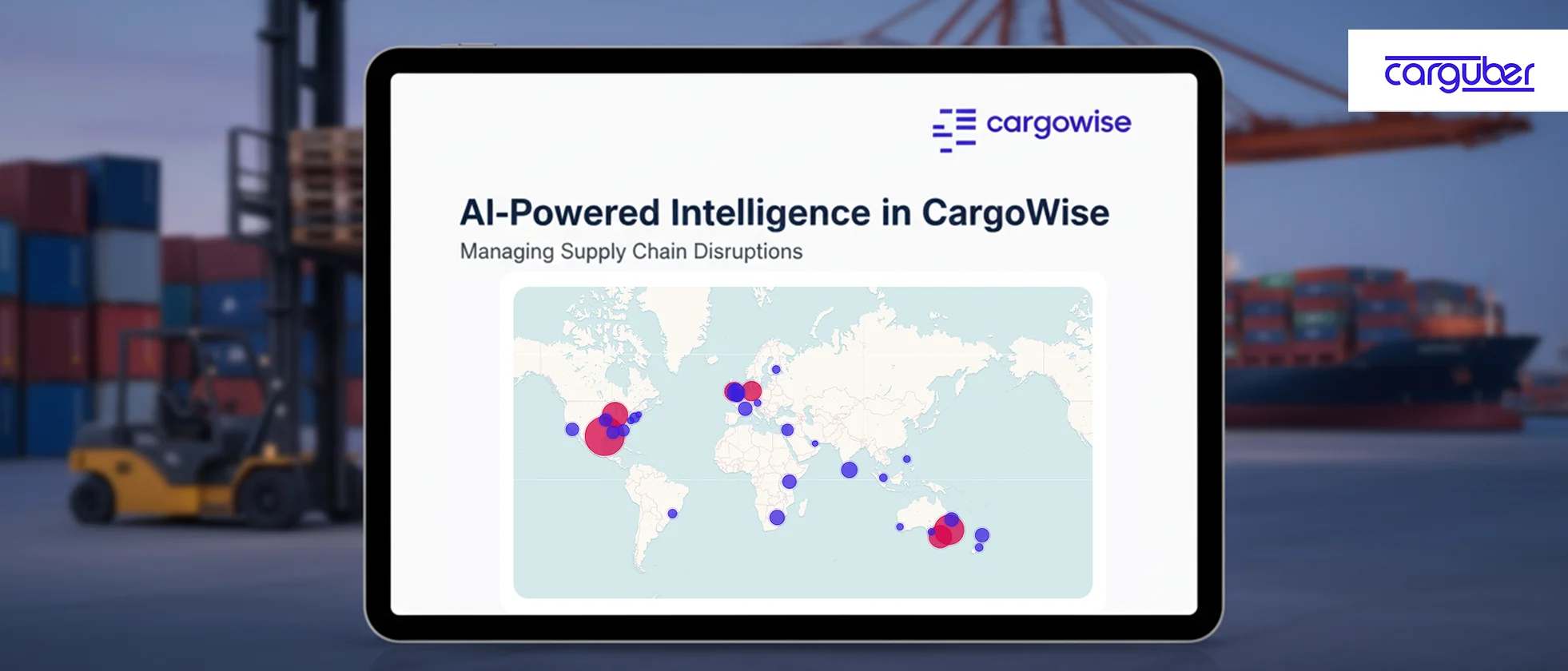
Data from the CargoWise network shows how quickly localized disruptions spread across global logistics operations. When geopolitical tensions or security concerns disrupt major trade corridors, the operational consequences frequently extend far beyond the originating region.
Aggregated and anonymized CargoWise network data highlights the scale of these disruptions.
Key insights include:
- Approximately 33,700 ocean jobs were disrupted, affecting nearly 200 vessels due to altered routing and carrier rotation changes
- Around 11,000 air shipments were disrupted, representing a 4.3% disruption rate during the same period
- Vessel rerouting and skipped port calls are impacting major maritime corridors and transshipment hubs
- Flight cancellations, rerouted services, and extended flight paths caused by airspace restrictions
- Massive effects are spreading across global trade lanes in the Americas, EMEA, and APAC regions
- Increased pressure on alternative ports and airports as carriers adjust routes and schedules
These findings demonstrate how disruptions in one region can quickly spread throughout interconnected supply chains, affecting shipment schedules, transit times, and cargo capacity globally.
How does CargoWise’s AI-Powered Intelligence Help Forwarders Optimize Global Supply Chain Disruptions?
As global logistics networks become more complex, freight forwarders must gain a better understanding of how disruptions impact active shipments. CargoWise’s AI-powered intelligence connects disruption signals to operational shipment data, enabling logistics teams to detect risks earlier and respond more effectively.
Shipment-Level Risk Visibility
CargoWise AI-powered intelligence allows forwarders to identify shipments that may be subject to disruption risk.
This helps logistics teams:
- Identify shipments affected by vessel rerouting or schedule changes
- Detect cargo booked on cancelled or delayed flights
- Understand which deliveries may be affected by changing trade lane conditions
- Monitor disruption exposure across both ocean and air shipments
Port-Level Intelligence for Ocean Shipments
Changes in vessel routing, port calls, or transshipment plans are common triggers for ocean freight disruptions.
CargoWise tools, such as Route Visualizer, enable logistics teams to assess operational conditions along planned vessel routes.
This visibility helps forwarders:
- Review vessel routes and port call sequences
- Identify risks related to skipped port calls
- Monitor congestion at transshipment hubs
- Evaluate geopolitical or security developments affecting maritime corridors
Real-Time Air Freight Disruption Visibility
Air freight operations can shift quickly when airlines reroute flights or cancel services due to airspace restrictions.
CargoWise incorporates cancelled flight status events into AWB automation workflows, giving users immediate visibility when flights are cancelled or changed.
This allows logistics teams to:
- Detect cancelled or rerouted flights affecting air shipments
- Identify impacted air consolidations quickly
- Trigger workflow alerts for operational teams
- Review shipment exposure across affected flight routes
Faster Operational Decision-Making
CargoWise helps forwarders make faster operational decisions by connecting disruption signals to shipment data.
This allows teams to:
- Adjust shipment routing plans
- Rebook cargo onto alternative vessels or flights
- Inform customers about potential delivery delays
- Coordinate alternative delivery arrangements
Integrated Airline Connectivity
CargoWise also helps with disruption management through integrations like AirlineConnect, which provides access to real-time airline schedules and cargo capacity data.
This integration helps forwarders:
- Access real-time airline schedules
- Monitor cargo capacity across connected airline systems
- Automatically update shipment data when flights change
- Reduce manual monitoring of airline schedule updates
By combining disruption intelligence with operational shipment data, CargoWise enables forwarders to move from reactive monitoring to proactive disruption management.
Conclusion
Supply chain disruptions are becoming more common and complex along global trade routes, making traditional monitoring methods obsolete for modern logistics operations.
CargoWise’s AI-powered intelligence allows forwarders to connect disruption signals to shipment-level visibility, resulting in faster responses and more operational control. However, this requires the proper configuration. Schedule a free call with us today, and we’ll help you.