How Will New GSP-Excluded Sections Impact Global Trade from 2026 to 2028?
In global trade, regulatory change rarely occurs overnight, but when it does, the consequences can be immediate and far-reaching. One such development is the upcoming update to the Generalized System of Preferences (GSP) for 2026-2028, which includes the introduction of new GSP-excluded sections. These changes will have a direct impact on import duties, trade eligibility, sourcing strategies, and customs compliance across global supply chains.
Understanding these changes in advance is no longer an option for logistics, customs, and trade professionals. With margins tightening and compliance requirements becoming more complex, staying informed is as important as remaining operational. This blog discusses how the new GSP-excluded sections will affect global trade and what businesses can do to prepare now.
Understanding GSP and Its Role in Global Trade
The Generalized System of Preferences (GSP) is a long-standing trade policy that aims to boost economic growth in developing and least-developed countries. GSP allows eligible countries to export certain goods to preference-granting markets with reduced or zero import duties, increasing their competitiveness.
For importers, GSP has traditionally meant:
- Reduced landing expenses
- Greater flexibility in sourcing
- Enhanced competitiveness of suppliers
GSP facilitates exporters’ access to key markets, thereby promoting industrial growth and employment. However, GSP does not remain static. Preference-granting countries regularly assess eligibility based on economic development, trade performance, and adherence to international standards.
What are GSP-Excluded Sections?
GSP-excluded sections are product or tariff categories that are no longer eligible for preferential treatment. When a section is excluded, goods classified under that heading are no longer eligible for GSP benefits, even if they come from a GSP-eligible country.
As part of a larger trade policy realignment, several exclusions are expected to go into effect between 2026 and 2028. These exclusions may be introduced because:
- Increased competitiveness of certain exporting countries
- Protection of domestic industries in importing nations
- Shifts in global manufacturing and trade flows
While exclusions are frequently targeted, their consequences can spread across entire supply chains.
Impact on Import Duties and Tariff Structures
One of the most immediate effects of GSP exclusions will be increased import duties on affected goods. Products that previously entered markets with reduced or zero duty may now be subject to full Most Favored Nation (MFN) rates.
This change can significantly alter cost structures:
- Importers face increased duty expenses
- Profit margins may shrink unless costs are passed on
- Pricing strategies may need revision
Even small duty increases can have a significant financial impact on high-volume or low-margin goods. Businesses that fail to plan for these changes in advance may face unexpected cost increases once the exclusions go into effect.
Effects on Country-Specific Trade Advantages
GSP exclusions can alter the competitive dynamics among exporting countries. When certain products lose preferential status, exporters may find themselves at a disadvantage in comparison to suppliers from countries that retain tariff benefits or are covered by free trade agreements.
This could lead to:
- Changes in sourcing away from previously preferred countries.
- Increased competition among exporters.
- Trade diversion to alternative markets.
Losing GSP benefits on key product categories can reduce export volumes and impede market access in developing countries. Importers must continually reassess supplier viability and long-term sourcing strategies.
Customs Compliance and Documentation Challenges
Aside from the cost implications, GSP exclusions complicate customs compliance significantly. Businesses should ensure the following:
- Goods are correctly classified under the unified system.
- Accurate country-of-origin compliance
- Preference claims are only applied where valid
Incorrect implementation of GSP preferences after exclusions take effect can result in:
- Duty underpayments
- Penalties and interest
- Post-clearance audits and reputational risk
As customs authorities tighten their oversight, particularly during transition periods, minor documentation errors can cause delays and compliance issues. For logistics teams, this means improved coordination between operations, customs brokers, and compliance specialists.
Supply Chain and Sourcing Strategy Implications
The GSP changes from 2026 to 2028 will force many businesses to reconsider their supply chain strategies. Businesses that rely heavily on the GSP benefits may need to:
- Re-evaluate supplier locations
- Explore alternative sourcing regions
- Renegotiate contracts to reflect new duty costs
Long-term procurement contracts may need to be renegotiated to reflect changing cost responsibilities. In some cases, businesses may decide to diversify their suppliers across multiple countries in order to reduce reliance on a single preference program.
Country-Wise GSP-Excluded and Key Regulatory Changes (2026–2028)
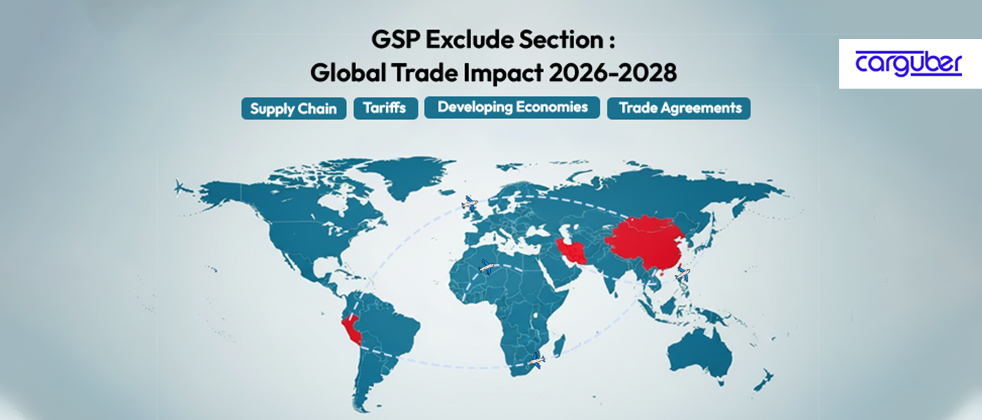
The EU’s GSP updates introduce origin-specific exclusions that directly impact tariff eligibility, compliance planning, and sourcing strategies. These changes require businesses to closely monitor product classification and country of origin to avoid incorrect preference claims and unexpected duty costs.
- India will face expanded GSP exclusions covering a wide range of industrial and manufactured goods, including mineral products, chemicals, plastics, rubber, textiles, metals, machinery, and transport equipment. Compared to the 2023–2025 period, India’s exclusion list now includes three newly added sections: mineral products, rubber, and motor vehicles and other transport equipment.
- Indonesia will see GSP exclusions applied to live animals and animal products (excluding fish), animal and vegetable oils and fats, mineral products, and wood and wood-based articles. In addition, Indonesia will exit the EU GSP system entirely from 1 January 2027, following its classification as an upper-middle-income country.
- Kenya will have GSP exclusions for live plants and floriculture products and will also leave the EU GSP framework on 1 January 2027, after entering into a broader preferential market access agreement with the EU.
Alongside these exclusions, the EU has already implemented a temporary suspension of GSP+ preferences for ethanol originating from Pakistan, effective from 21 June 2025 and lasting until June 2027, due to market disruption concerns.
How does Carguber Help Businesses Navigate GSP Exclusions (2026-2028)?
As GSP exclusions alter duty structures and compliance requirements, businesses require more than just awareness; they also need practical execution support. Carguber helps organizations transform regulatory changes into operational readiness by combining trade compliance with CargoWise configurations and real-world workflows. Instead of reacting after exclusions are implemented, businesses can proactively assess risks, control costs, and ensure supply chain compliance.
Carguber facilitates this transition by:
- Simplifying interpretation of GSP exclusions and regulatory updates, helping teams clearly understand which products, sections, and trade lanes are affected.
- Ensure accurate HS classification and preference eligibility checks to avoid incorrect GSP claims, duty underpayments, and audit exposure.
- Supporting customs compliance through CargoWise configuration and reporting, which allows for the proper application of rules in day-to-day operations.
- Assessing duty impact and cost changes prior to implementation, allowing businesses to model scenarios and adjust sourcing or pricing strategies in advance.
- Enabling proactive trade decision-making with data-driven insights, so compliance, finance, and logistics teams work from a single, reliable source of truth.
By combining regulatory knowledge with CargoWise expertise, Carguber helps businesses move from compliance risk to compliance confidence, well ahead of the 2026–2028 GSP changes.
Conclusion
The new GSP-excluded sections, which are set to take effect in 2026-2028, will reshape global trade by influencing costs, compliance, and competitiveness across supply chains. While difficult, these changes open up opportunities for smarter sourcing, better data management, and stronger trade strategies.
To confidently navigate change, early preparation and the right expertise are required. Are you ready to get ahead of the GSP changes? Book a call with Carguber today to assess your GSP exposure and develop a proactive strategy before the changes affect your business.