What does the EU–India FTA Mean for Global Trade and Supply Chains?
What if one trade agreement could unlock billions in savings, double export potential, and reshape global supply chains?
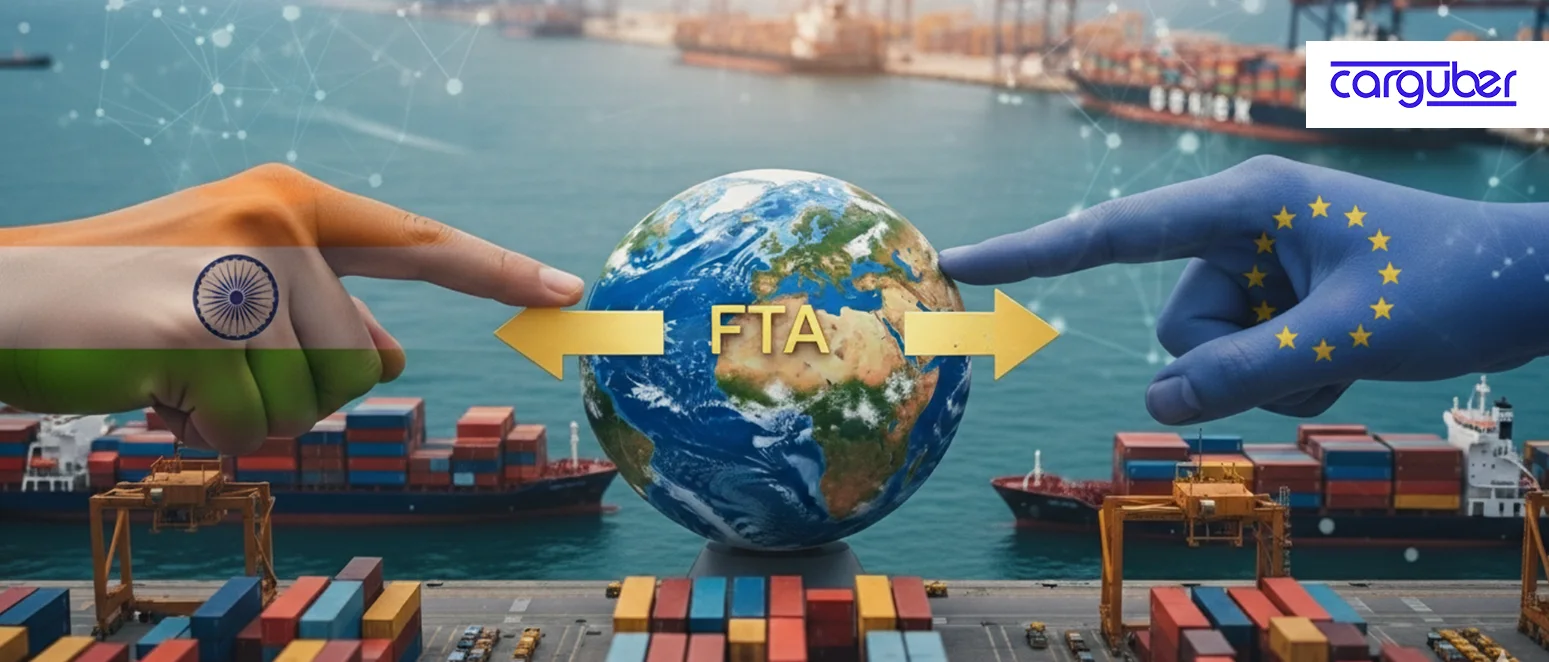
Yes, the recent 2026 EU–India Free Trade Agreement (FTA) is set to do so. Covering a market of more than 2 billion people and nearly 25% of global GDP, the deal tackles some of the world’s highest trade barriers, cutting tariffs as high as 150%, reducing red tape, and opening the door to up to €4 billion in annual duty savings. With EU exports to India already at €75 billion and expected to grow significantly, the FTA marks a turning point in how Europe and India trade.
This blog explores what the EU–India FTA really means for exporters, freight and logistics providers, and global supply chains, breaking down the commercial benefits, operational challenges, and how to prepare for FTA execution.
Understanding the FTA (Free Trade Agreement)
A free trade agreement is designed to reduce barriers to trade between two economies. Traditionally, FTAs focused mainly on lowering tariffs. Modern FTAs, including the EU–India agreement, go much further by addressing:
- Goods and services trade
- Customs procedures and risk management
- Rules of origin
- Digital trade and data governance
- Intellectual property protection
- Sustainability and labour standards
- Dispute settlement mechanisms
Reality?
Tariff benefits from an FTA are not automatic. You must be properly claimed, justified, and demonstrated using compliant documentation and accurate data.
Why did the EU Choose India as a Strategic Trade Partner?
India’s role in the global economy has expanded rapidly over the past decade. Now the world’s fourth-largest economy and home to the largest population, it is a major hub for manufacturing, services, and technology. Yet EU exports have long fallen short of their potential due to high tariffs and complex trade barriers. The EU–India Free Trade Agreement aims to unlock this untapped opportunity while strengthening economic and political ties between the world’s two largest democracies amid growing global uncertainty.
Key reasons behind the EU–India FTA:
- India represents a market of over 1.45 billion consumers with a rising demand for high-quality goods and services
- Indian import tariffs on EU goods have been among the highest applied by any major trading partner.
- The FTA aims to make trade easier, cheaper, and faster by reducing tariffs and administrative burdens
- EU exports to India already support around 800,000 jobs in the EU, with strong potential for further job creation
- The agreement strengthens long-term economic resilience and supply chain diversification for both regions
How does the FTA Affect EU-India Trade Flows?
The EU–India FTA fundamentally alters the cost structure and pace of trade between the two regions. By cutting tariffs on the vast majority of goods and simplifying customs procedures, the agreement reduces both direct trade costs and hidden operational delays.
How the FTA changes cost and speed in practice:
- Tariffs were eliminated or reduced on 96.6% of EU goods exports, significantly lowering landed costs
- Up to €4 billion per year in duty savings, directly improving exporter margins
- Simplified and harmonised customs procedures, reducing clearance times at borders
- Lower administrative burden, with fewer manual checks and repetitive filings
- More predictable trade rules, enabling better planning of inventory, pricing, and delivery schedules
In short, the EU-India FTA transforms trade from a high-cost, high-friction model to a faster, more competitive framework, with businesses that align their systems, data, and documentation early on being best positioned to capture the full value of the agreement.
How Will the Agreement Affect EU Exports?
The EU–India FTA significantly improves the commercial and operational environment for exporters by addressing both cost-related and process-related barriers to trade. Reduced tariffs and simplified customs procedures make cross-border trade more predictable and efficient, helping businesses move goods faster while protecting margins.
Key impacts include:
- Up to €4 billion per year in duty savings
- Faster customs clearance and reduced delays
- Greater certainty for long-term contracts
- Expanded opportunities in the services trade
However, these benefits are only available if exporters correctly claim preferential tariffs, which necessitates accurate classification, origin management, and documentation.
Benefits of the EU–India FTA by Industry
Examples of EU Industrial Sectors that will Benefit
EU Industry (Goods Exports)
| Sector | EU Exports to India (2024) | Current Tariffs | Future Tariffs |
| Machinery & Electrical Equipment | €16.3 billion | Up to 44% | 0% for almost all products |
| Aircraft & Spacecraft | €6.4 billion | Up to 11% | 0% for almost all products |
| Optical, Medical & Surgical Equipment | €3.4 billion | Up to 27.5% | 0% for 90% of products |
| Chemicals | €3.2 billion | Up to 22% | 0% for almost all products |
| Plastics | €2.2 billion | Up to 16.5% | 0% for almost all products |
| Pearls, Precious Stones & Metals | €2.1 billion | Up to 22.5% | 0% for 20%; reduced for 36% |
| Motor Vehicles | €1.6 billion | 110% | 10% (quota of 250,000 vehicles/year) |
| Iron & Steel | €1.5 billion | Up to 22% | 0% for almost all products |
| Pharmaceuticals | €1.1 billion | 11% | 0% for almost all products |
EU Service Providers
| Service Area | Benefit Under the FTA |
| Financial Services | Most ambitious commitments India has offered in any trade agreement |
| Maritime Services | Privileged access and improved regulatory transparency |
| Market Access | Binding of current liberalisation levels |
| Regulatory Framework | Clearer rules on local presence and governance |
| Business Expansion | Greater certainty for long-term investments |
EU Farmers and Agri-Food Exporters
| Agri-Food Product | Current Tariffs | Future Tariffs |
| Wine | 150% | 20% (premium); 30% (medium range) |
| Spirits | Up to 150% | 40% |
| Beer | 110% | 50% |
| Olive Oil & Vegetable Oils | Up to 45% | 0% |
| Kiwis & Pears | 33% | 10% (in-quota) |
| Fruit Juices & Non-Alcoholic Beer | Up to 55% | 0% |
| Processed Food (bread, pasta, biscuits, chocolate, pet food) | Up to 50% | 0% |
| Sheep Meat | 33% | 0% |
| Sausages & Meat Preparations | Up to 110% | 50% |
Small Businesses (SMEs)
| SME Benefit Area | Impact |
| Tariff Reductions | Lower export and import costs |
| Customs Simplification | Faster, easier clearance |
| Regulatory Transparency | Clear access to trade rules |
| Predictability | Stable and long-term trade framework |
| Dedicated SME Chapter | Support mechanisms for small exporters |
The Real Challenges of FTA Execution
While the EU-India FTA simplifies trade rules on paper, the true complexity emerges at the execution level. When freight forwarders manage documentation, customs compliance, and system integration, even minor gaps can cause clearance delays, invalidate tariff benefits, and necessitate costly rework.
Key challenges faced by freight and logistics providers include:
- Managing complex documentation such as certificates of origin and shipment declarations
- Ensuring consistent data across ERP, finance, and customs systems
- Handling rules of origin verification without structured supplier data
- Tracking tariff staging and quota limits
- Responding to stricter customs validations on FTA claims
- Scaling operations without increasing errors or workload
- Avoiding CDS rejections, penalties, and rework
Freight and logistics providers do more than just transport goods; they ensure trade eligibility, compliance accuracy, and speed. Ultimately, the success of the EU-India FTA will be determined by how well these challenges are addressed through system integration, automation, and clean data flows.
Carguber Enables FTA-Ready Freight & Logistics Execution
Carguber helps freight forwarders and logistics providers bridge the gap between FTA policy and day-to-day execution. Automating customs documentation and integrating directly with ERP and customs systems, it removes many of the operational bottlenecks that prevent logistics teams from fully realizing FTA benefits.
How we support freight and logistics providers in practice:
- Automates customs documentation and reduces manual data entry
- Ensuring data consistency from ERP to customs systems through end-to-end integration
- Validates compliance to prevent rejections and rework
- Enables accurate FTA claims with traceable data
- Speeds up clearance with clean, complete submissions
- Provides real-time visibility and audit-ready records
By transitioning customs processes from manual to automated, system-driven workflows, we provide end-to-end logistics support, allowing you to confidently scale EU-India trade volumes without increasing compliance risk or operational overhead.
Conclusion
As the EU-India Free Trade Agreement approaches implementation, businesses’ focus shifts from understanding the agreement to effectively executing it. For freight forwarders and logistics teams, being prepared ahead of time can mean the difference between capturing tariff benefits and experiencing avoidable delays or compliance issues.
Schedule a call with our team to assess how your current customs and documentation processes can be better aligned for trade between the EU and India. We’ll go over practical ways to simplify execution, reduce risk, and support scalable, FTA-ready operations at a pace that suits your company.