Is it becoming increasingly difficult to comply with export regulations?
If you work in freight forwarding or global trade, you are not imagining it.
Compliance has not simply changed; it has become more complex, technical, and demanding than it was even a few years ago.
Global trade is increasing, but so are restrictions.
Geopolitical tensions, from the Ukraine conflict to evolving dynamics in the Middle East and ongoing U.S.–China competition, are reshaping how export controls are defined and enforced across the world.
📊 A New Level of Regulatory Pressure
Let’s look at what’s happening globally:
- The European Union has introduced 19 sanctions packages, covering over 2,700 individuals and entities
- The United States has expanded its Entity List and tightened Export Administration Regulations (EAR)
- Countries like the UK and Australia are strengthening their own control frameworks
What does this mean for your operations?
- More screening requirements
- More complex classification decisions
- More jurisdictions to comply with in a single shipment
Compliance is no longer a final checkpoint. It is now part of the entire shipment lifecycle.
⚙️ Dual-Use Goods are Now Everywhere
Earlier, export controls focused mainly on clearly defined military or high-risk goods.
Today, that boundary has shifted.
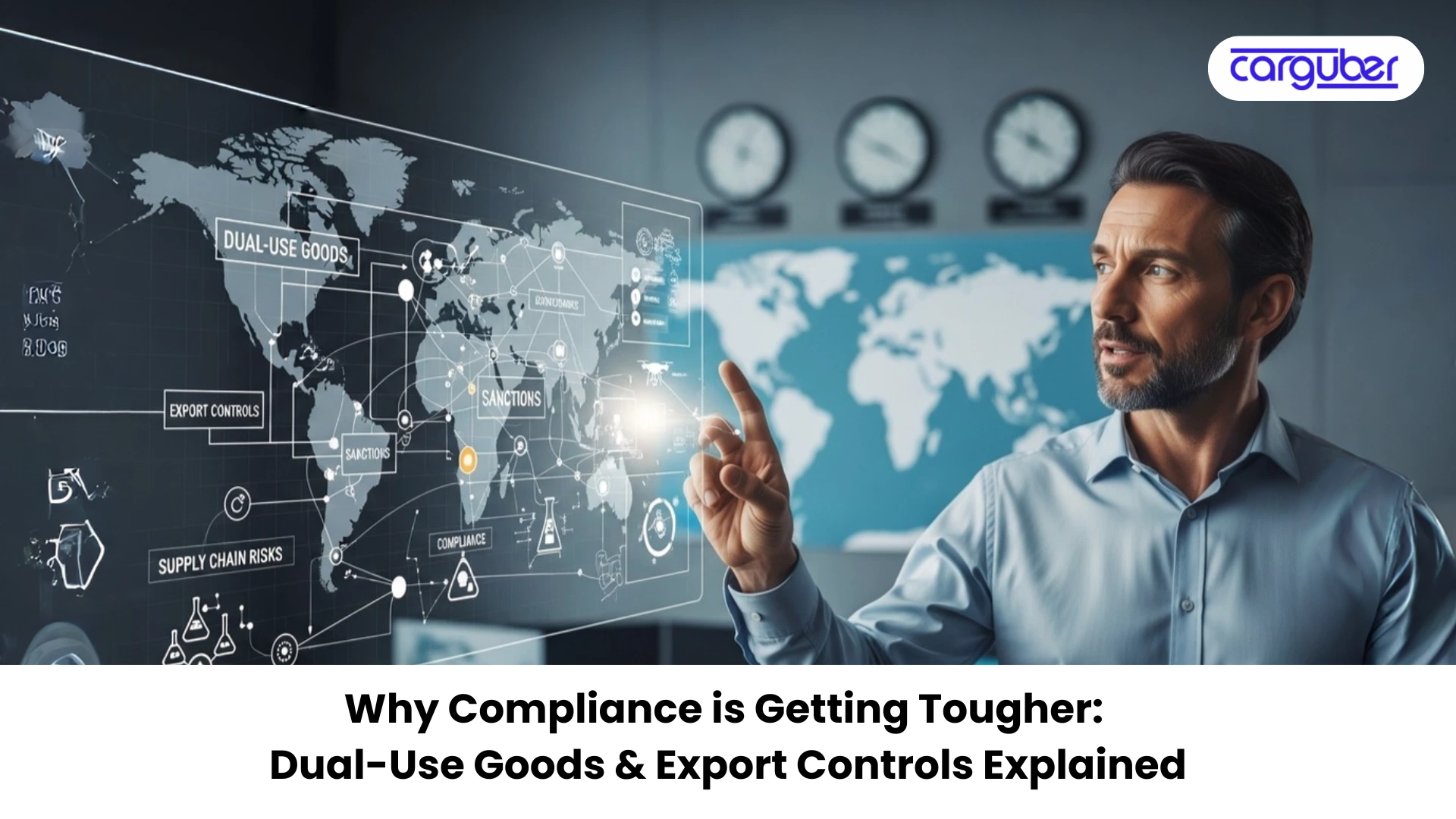
Dual-use goods, items that can be used for both civilian and military purposes, are becoming part of everyday trade.
Recent regulatory changes, including EU-specific controls and evolving global frameworks, now cover:
- Advanced semiconductors
- Quantum technologies
- Rare materials and industrial components
But here’s the real challenge:
Even standard electronics and equipment can now fall under control lists, not because of the final product, but because of the components inside them.
🔍 Technology is Making Classification More Complex
Modern products are no longer simple.
Take a common example, a smartphone.
It contains:
- High-performance processors
- Sensors
- Communication modules
Each of these can fall under different regulatory controls depending on its specifications.
Now add software into the picture.
A product that is unrestricted in its base form can become controlled once certain firmware or capabilities are enabled.
This means that classification is no longer based on “What is the product?”
It is about “what it contains and how it can be applied.”
🌍 Different Countries, Different Rules
Another key challenge?
There is no single global standard.
The same shipment may need to comply with:
- U.S. export regulations at origin
- EU dual-use rules during transit
- Destination country import controls
For freight forwarders, this creates a complex reality:
- One shipment
- Multiple regulatory frameworks
- Overlapping compliance requirements
On top of this, regulators are actively monitoring transshipment routes to prevent goods from being diverted to restricted end users.
🚢 Freight Forwarders are Now Compliance Gatekeepers
Here’s where the pressure really builds.
Authorities increasingly expect freight forwarders to act as active compliance participants, not just logistics providers.
But the challenge is clear:
You often work with:
- Limited product details
- Generic cargo descriptions
- Incomplete technical information
For example:
A shipment described as “thermal imaging cameras.”
may or may not require licensing, depending on specific technical parameters like frame rate.
Without detailed specifications, making the right compliance decision becomes difficult.
Now multiply this across hundreds of shipments every week.
👉 This is where operational pressure meets compliance risk.
📈 Trade Growth is Increasing the Burden
Global trade continues to grow:
- Manufacturing trade increased by around 10%
- The electronics trade grew by approximately 14%
These are the same sectors under the highest dual-use scrutiny.
This creates a constant operational dilemma:
- Move faster and risk compliance gaps
- Slow down and impact delivery timelines
Neither approach is sustainable for modern logistics operations.
💡 So, How do You Stay Ahead?
To manage this complexity, logistics teams are gradually shifting towards:
- Automated screening across multiple sanction lists
- Better product classification support
- Centralised compliance workflows
- AI document management and tools to reduce manual effort
Because manual processes alone are no longer enough to handle the scale and speed of global trade today.
🤝 Need Help Managing Compliance?
Export compliance is no longer just a regulatory requirement; it’s a critical part of operational success.
If your team is:
- Spending too much time on manual checks
- Struggling with dual-use classification
- Facing delays due to compliance uncertainty
👉 You don’t need to handle it alone.
The logistics support and helpdesk team is here to assist you, from compliance guidance and document validation to improving your operational workflows. Let’s make your compliance process clearer, faster, and more reliable.