Shipping documentation has always been at the heart of international trade. Every shipment requires accurate documentation to cross borders, clear customs, and arrive at its final destination without delay. However, the evolution of document creation, sharing, and management is occurring at an unprecedented rate.
Traditional documentation methods are slowing down as shipment volumes rise, compliance requirements become more stringent, and customer expectations increase. What was once effective has now resulted in gaps in speed, visibility, and coordination. So, the real question is, are your documentation processes still manual, or have you switched to digital trade?
🌍 What’s Changing in Trade Documentation Today?
Across the logistics industry, there’s a strong push toward digitization, especially when it comes to critical documents like Bills of Lading.
Why?
Because traditional processes come with challenges:
- Documents move more slowly than shipments
- Manual handling increases the risk of errors
- Delays in documentation can hold up cargo release
- Paper-based workflows reduce visibility and control
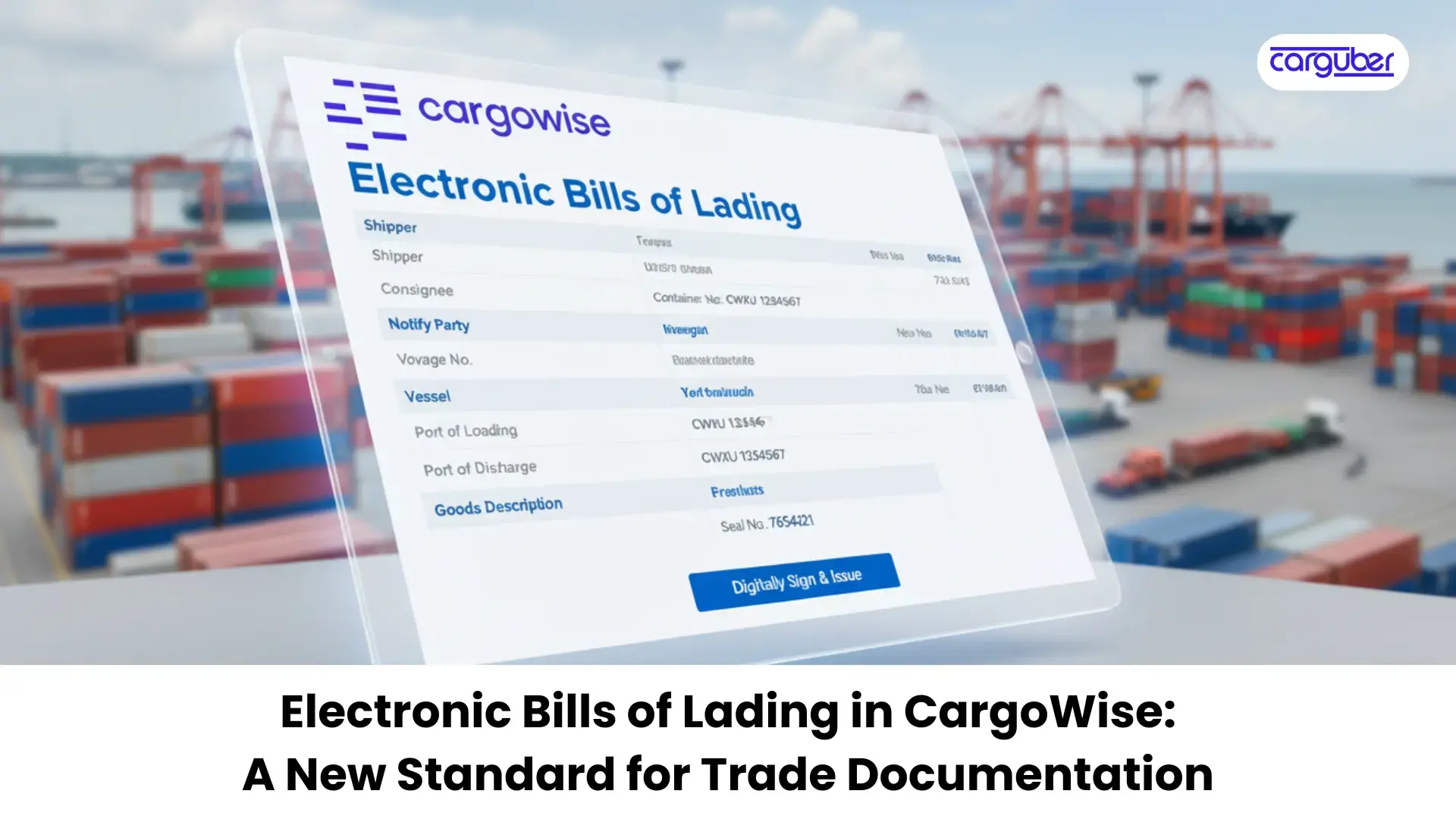
Now, companies are shifting toward electronic Bills of Lading (eBL) to simplify and speed up the entire process.
📊 Why Electronic Bills of Lading Matter More than Ever?
Think about how much depends on a bill of lading:
- It confirms shipment ownership
- It acts as a contract of carriage
- It’s required for cargo release and financial processes
When this document is delayed, everything slows down.
With electronic Bills of Lading:
- 📄 Documents are created and shared instantly
- 🔍 Visibility improves across all stakeholders
- ⏳ Processing time is reduced significantly
- 🔐 Security and control are strengthened
It’s not just a digital upgrade. It’s a shift toward faster and more reliable trade execution.
🔍 Where does CargoWise Fit Into this Shift?
Platforms like CargoWise are playing a key role in enabling this transition.
Instead of managing documents outside the system, CargoWise allows teams to
- Create and manage electronic Bills of Lading within their workflow
- Connect documentation with shipment data
- Reduce manual intervention across processes
- Improve coordination between operations, customers, and partners
This creates a more connected and efficient documentation process.
🚀 What Changes When You Move to eBL?
When electronic Bills of Lading become part of your workflow, the impact is immediate.
You start to see:
- Faster document turnaround times
- Reduced dependency on manual processes
- Improved accuracy and fewer corrections
- Better visibility for customers and partners
- Smoother coordination between operations and finance
In simple terms, your documentation starts moving at the same speed as your shipments.
📊 Why does this Matter for the Future of Logistics?
Global trade is becoming more digital, more connected, and more time-sensitive.
Companies that continue to rely on traditional documentation processes may face the following:
- Slower operations
- Higher risk of delays
- Limited visibility
- Reduced competitiveness
On the other hand, those adopting digital documentation are gaining:
- Faster execution
- Better control
- Stronger customer experience
🔍 Is Your Documentation Process Slowing You Down?
Take a moment to reflect on how your current documentation workflow actually performs:
- How fast can your team create and share a Bill of Lading?
- Do delays in documentation ever hold up shipment release?
- Are you still relying on emails, PDFs, or manual file exchanges?
- Can your customers access documents instantly without follow-ups?
If any of these seem like everyday challenges, it could be a sign that your documentation process isn’t keeping up with operational and global trade demands.
🚀 Final Thoughts
Electronic Bills of Lading are more than just a trend. They are becoming the norm for modern logistics operations. Because, at the end of the day, faster documentation leads to faster decisions, faster cargo release, and better business results.
If your documentation process still feels slow or disconnected, it might be time to rethink your approach.
Get the right logistics support and helpdesk to lead your transition toward digital documentation, simplify your workflows, improve overall efficiency, and let your operations move faster with the right systems and support in place.